


2026-02-25 updated

A paper has been published in Regenerative Medicine, Vol. 25-1, the official journal of the Japanese Society for Regenerative Medicine.
Cybernics Treatment for Promoting Functional Improvement and Regeneration of the Brain, Nervous System, Body, and Physiological Systems
― Combined Therapies with Regenerative Medicine and Pharmaceuticals, Wearable Cyborg, and AI Robots ―
Yoshiyuki Sankai
1 Executive Director, Professor, Center for Cybernics Research/Director/F-MIRAI Center, Univ. of Tsukuba
2 President & CEO, CYBERDYNE Inc.
3 Program Director, Strategic Innovation Promotion (SIP) Program, Cabinet Office of Japan
SUMMARY
Cardiovascular diseases such as cerebrovascular disorders, atrial fibrillation causing thrombosis, diabetic foot complications, frailty-related falls, and progressive diseases are social issues facing the world.
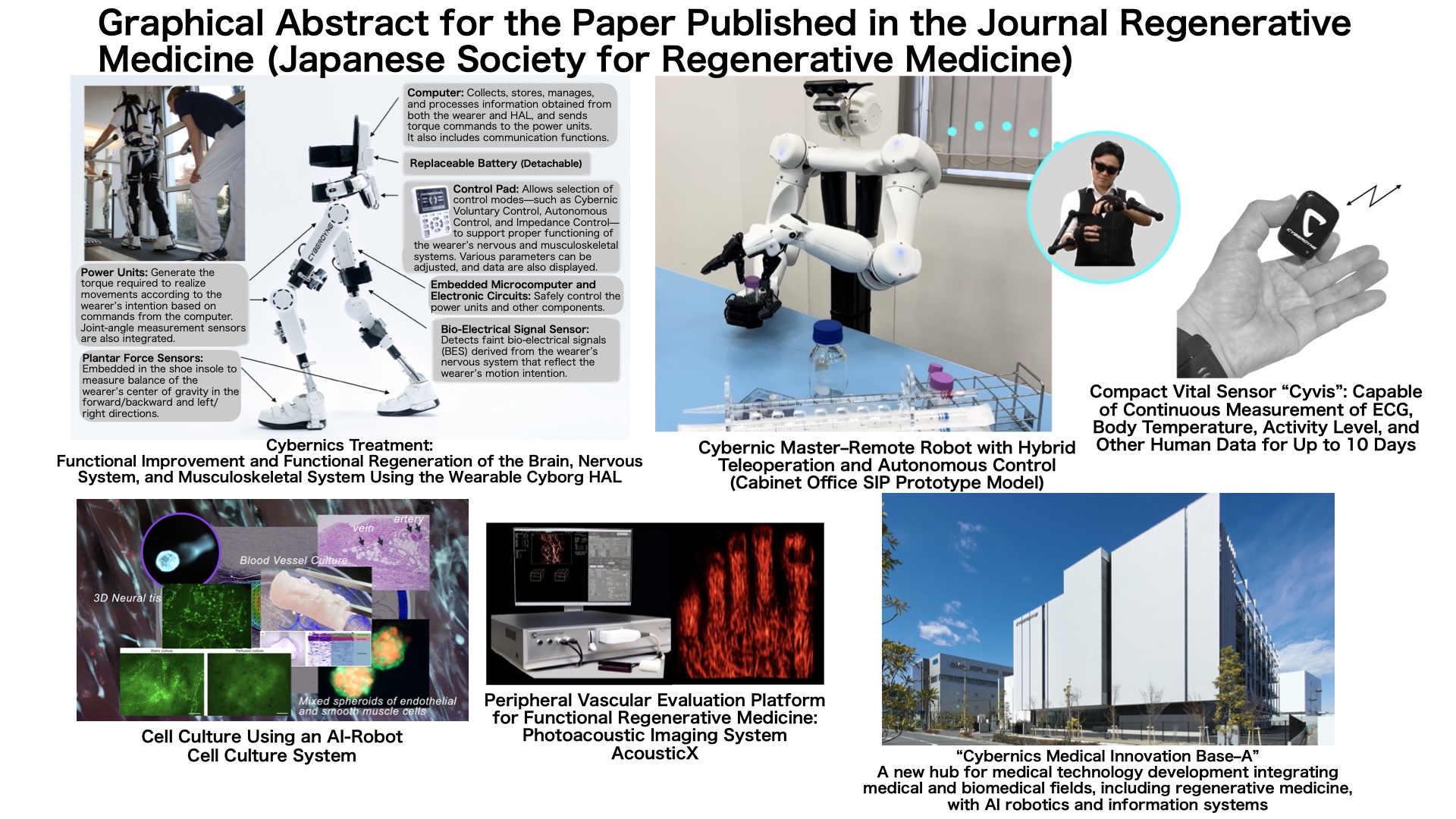
Against this backdrop, “Cybernics Treatment” ― integrating bio/medical systems with AI/robotics/information systems ― is drawing intense global attention. Cybernics Treatment has centered on the Wearable Cyborg HAL, forming an integrated therapeutic system promoting functional improvement and regeneration of the brain, nervous system, and body.
Recently, efforts toward combined therapies integrating pharmaceuticals with Cybernics Treatment have begun. In the treatment of spinal muscular atrophy (SMA), the combination of the nucleic acid therapeutic Nusinersen and HAL has demonstrated cases of functional improvement that could not be achieved with Nusinersen alone.
Furthermore, efforts toward combined therapies integrating regenerative medicine with Cybernics Treatment are advancing. Regenerative medicine enables regeneration at the cellular and tissue level, while Cybernics Treatment promotes regeneration at the level of motor function. Cybernics Treatment facilitates the functional integration of transplanted cells, accelerates the formation of new neural pathways, and induces use-dependent plasticity after transplantation. Therefore, combined use with regenerative medicine products, including exosome therapies, has the potential to significantly enhance the speed and quality of functional reconstruction and regeneration.
For the widespread implementation of regenerative medicine, process standardization and high-quality production are essential. Incorporating the outcomes of the Cabinet Office’s SIP Human-Collaborative Robotics initiative, AI-robotized cell culture systems and the Cybernic Master-Remote Robot (HCPS-integrated Physical AI) will be deployed to reproduce skilled expertise, enable high-quality cell culture, achieve contamination-free production, and ensure stable supply. These systems will be introduced in phases at the “Cybernics Medical Innovation Base” established in King Skyfront (Tonomachi), adjacent to Haneda Airport, serving also as an international collaboration hub.
In addition, the integration of the photoacoustic imaging system (AcousticX) as a peripheral vascular evaluation platform, continuous vital data monitoring (Cyvis), and patient data integration and AI analysis (C-Cloud) will promote HCPS-integrated Cybernics Medical and Health Innovation. Through domestic and international collaboration, this framework aims to realize “functional regenerative medicine” that comprehensively improves cells, tissues, neural circuits, physical functions, and daily life activities.
© 2026 CYBERDYNE INC. ALL RIGHTS RESERVED.